

Stop Chasing Leads: Meet Tom Leto
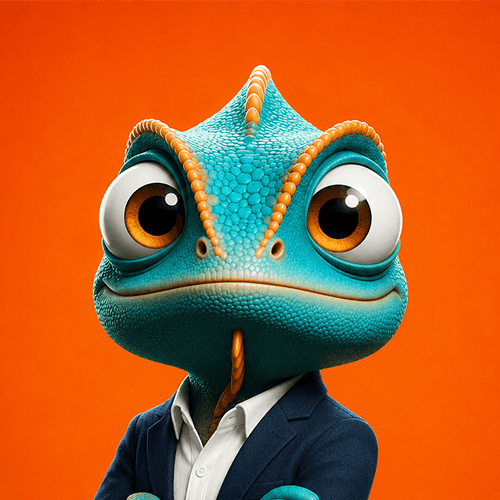
There is a judge's gavel on Tom Leto's desk.
I feel like we should address that immediately.
It isn't decorative in the traditional executive-office sense. Tom is Cracked Egg Creative's Chief of Strategic Development, which means he spends his days thinking about pipeline, revenue, business development and how companies turn conversations into customers.
None of those responsibilities require judicial authority.
Yet the gavel remains.
I decided not to question it too aggressively because Tom also told me his dream vacation involves freediving with a great white shark, his favorite app tracks shark activity, his preferred emoji is anything involving a shark, and when asked whether he runs on coffee, tea or energy drinks, he answered:
“Pure Chaos!”
There are moments in an interview when you realize the person sitting across from you has already given you the story.
This was one of them.
Because Tom is, in many ways, a collection of things that shouldn't necessarily fit together but somehow do: a revenue obsessive who cares deeply about relationships. A strategist who believes rules are mostly invitations to find new boundaries. A pipeline guy who thinks businesses have become far too impersonal. A man who hates losing more than he loves winning but insists integrity comes before any win.
And somewhere underneath all of it is a guy who got his first taste of marketing by putting flyers on cars at all-girls private schools to promote a high school hockey game.
We should probably start there.
It Started With a Hockey Game
Tom isn't completely sure what originally inspired him to pursue marketing and business development. He does, however, remember the first time he saw what marketing could do.
He and some friends wanted more people at a high school hockey game. So they made a flyer, printed a few hundred copies and strategically distributed them on cars at several all-girls private schools.
I have questions about the segmentation methodology. But apparently it worked. The game drew one of the biggest crowds of the year.
Long before Tom had language like pipeline generation or audience targeting, he had experienced the basic thrill of marketing: put the right message in front of the right people, give them a reason to care, and something happens.
Tom eventually studied Media Communications and Marketing at Webster University, but some of his better lessons happened well outside a classroom. He studied and worked in Thailand, contributed to agency work for international brands, managed promotional events and eventually got the chance to design a promotional booth for Webster itself.
The assignment was simple: increase awareness and, ideally, break even.
Tom failed.
He made a profit.
He still considers that one of those quietly satisfying career accomplishments because it reinforced something a mentor, David Howell, taught him early: there is a difference between the idealistic solution and the realistic one. Anyone can dream up the biggest idea with an unlimited budget. The harder job is creating the best idea that fits the resources and actually solves the problem.
David also gave Tom another piece of wisdom:
“There's only one difference between genius and stupidity, and it's that genius has its limits.”
Tom still finds that funny. As Chief Happiness Officer, I consider this an important contribution to the company knowledge base.
He's a Revenue Guy. Just Not the Kind You're Thinking Of.
Eventually, Tom's career moved deeper into marketing, business development and growth. At iClips Network, grassroots campaigns helped grow the platform's user base by 200% in less than six months. He later spent nearly twelve years at LinkedSelling, working across B2B outreach, client success and pipeline strategy.
This is where I expected our conversation to become very sales-y. It didn't.
Tom certainly likes revenue. He likes winning even more, which we will get to because apparently that requires its own section. But the more he talked about business development, the more obvious it became that what bothers him most is how easily businesses forget there is an actual person on the other side of the sale.
A prospect becomes a lead. A lead becomes a record in a CRM. A record enters an automated sequence.
Congratulations. We have successfully transformed a human being into a row of data.
Tom hates that.
He believes businesses have become so obsessed with efficiency, automation and scale that they sometimes strip the relationship out of the process meant to create one. Everyone is communicating. Very few people are actually connecting.
For a guy who spends his days thinking about business development, Tom talks about care more than I expected. Not performative care. Not dropping {First_Name} into an email and declaring it personalized. Actual care about whether the person on the other side succeeds.
He wants to understand where a business is trying to go and what is standing in its way. Then he wants to help. The specific tactic might change, but the reason he's there doesn't.
The tactic isn't the point.
The relationship is.
And Tom believes the best client relationships eventually stop feeling like a company hired a vendor and start feeling like two teams are trying to win the same game. Which, knowing Tom, is probably the only acceptable kind of game.
Tom Has Opinions About Losing
This brings us to the competitive part.
When I asked Tom what being Built Different means to him, he gave me an answer I had not heard before:
“Having no ego when it comes to not losing. We hate losing more than we love winning.”
I had to think about that one for a minute.
Mostly because I am a chameleon and my primary competitive advantage is becoming part of a wall.
But the more Tom explained it, the more it made sense.
There is a difference between wanting to win because your ego needs the trophy and hating to lose because losing means there was something you could have done better.
Tom is much closer to the second.
If something misses, he wants to know why.
If a strategy isn't working, change it.
If the conventional answer isn't producing the result, question the conventional answer.
And if somebody tells him there is a boundary, there is at least a reasonable chance Tom is going to walk over and push on it just to make sure everyone agrees that it is, in fact, a boundary.
When I asked which business or leadership rule deserves to be broken, his response was essentially:
Aren't rules made to be broken?
Push until you find the new boundary.
Then repeat.
This could sound mildly concerning coming from the man with a judge's gavel on his desk.
Except there is one boundary Tom will not push.
Integrity.
And this is where the competitive guy who hates losing becomes much more interesting.
Tom is unequivocal about it:
A man is only as good as his word.
Not when keeping it is convenient.
Not when the deal is going well.
Not when there is nothing at stake.
Your word matters most when keeping it costs you something.
No revenue target, client opportunity, commission, shortcut or win is worth compromising your ethics to get there. Tom wants the win, very badly, apparently, but not badly enough to become someone he would not respect in order to get it.
That matters here.
Integrity is one of Cracked Egg Creative's core values, but core values are very easy to put on a website. They become real when they influence the decisions you make when nobody would blame you for choosing the easier option.
For Tom, integrity is not a sales strategy.
It isn't something you perform because trust happens to be good for business.
It's the line.
You can challenge the process. Challenge the strategy. Challenge the conventional answer. Push the boundary. Break the rule that stopped making sense ten years ago.
But your word?
That stays intact.
There is something reassuring about knowing that the guy who hates losing still knows there are things more important than winning.
Especially when that guy is responsible for strategic development.
And has a gavel.
Success Should Eventually Make the Risk Look Obvious
That combination, competitive enough to hate losing, curious enough to challenge the usual answer and grounded enough to know there are lines you do not cross, is probably the best way to understand how Tom approaches his role at Cracked Egg Creative.
He joined the company in August 2026 as Chief of Strategic Development, which gives him room to work on the thing he genuinely enjoys: helping businesses figure out how to get from where they are to wherever they are trying to go next.
And despite everything I have just told you about his feelings toward losing, Tom does not define success entirely by whether he wins. He defines it by whether the client does.
When I asked what success looks like in his role, he talked about scaling, growth and sharing knowledge. He wants people around him to understand why something works, not just wait for him to tell them what to do.
His definition of leadership follows the same idea:
“Building a team so good they could crack the code without you, and choosing to anyway.”
That's a very Tom definition of leadership. Make people better. Give them room. Build something they want to be part of.
Then he gave me his definition of success:
“When your clients' growth makes them forget you were ever a risk.”
That one stopped me. Because every new client relationship starts with some version of the same question: Are we making the right choice?
Tom doesn't think you answer that question with a sales pitch.
You make them forget they ever had to ask it.
We Need to Talk About the Sharks
At this point, I had learned quite a bit about Tom the strategist.
Then the questionnaire began revealing Tom the person.
This is where things became less predictable.
His friends, according to Tom, would probably describe him as loyal, a man of his word and “crazy fun.” He is an extrovert, a night owl and a beach person. He runs on pure chaos, prefers PC over Mac, likes sweet over salty, and can somewhat play the piano.
Somewhat.
I respect the qualifier.
His nickname is Ace, acquired at university because of Ace Ventura. He says he will answer to almost anything, which is why, when asked what candy bar he would be, he selected a Whatchamacallit.
That is annoyingly good.
Then there are the sharks.
Tom's favorite app is Sharktivity, which tracks shark activity.
His favorite emoji is anything involving a shark.
And his dream vacation is freediving with a great white shark.
Not observing one from a boat.
Not seeing one through reinforced glass.
Freediving.
With it.
I would like to remind everyone that Tom is responsible for strategic development.
Risk assessment may be handled by another department.
The shark fixation does, however, make the judge's gavel seem considerably less strange.
His desk could have contained almost anything.
Of course it contains a gavel.
The Part Tom Actually Cares About
There's a lot about Tom that is easy to notice.
He's competitive. Loud about growth. Comfortable challenging the answer everyone else has already accepted. He owns a judge's gavel for reasons I still don't completely understand and would willingly enter the ocean with an animal specifically designed to make that a terrible idea.
But I don't think any of those things are the most interesting part of him.
The interesting part is what happens when Tom decides he's in your corner.
He's in.
Your problem becomes his problem. Your goal becomes something he wants to help reach. Your win matters to him. And whether you're a client, a colleague or someone on his team, he takes the relationship seriously.
Maybe that's why so much of his career has revolved around growth. Not because Tom particularly enjoys watching numbers move on a dashboard. Because there are people attached to them.
Businesses someone took a risk to build. Teams trying to make something work. Clients trusting you with something that matters to them.
Tom wants to help them win. And yes, he would strongly prefer that we all win. Losing remains unacceptable.
I asked Tom what he wanted people to remember from our conversation. His answer was simple:
“Care about what you do and the people you do it with.”
There it is. Not pipeline. Not revenue. Not the gavel.
Care.
Although knowing Tom, he'll probably find a way to measure that too.