
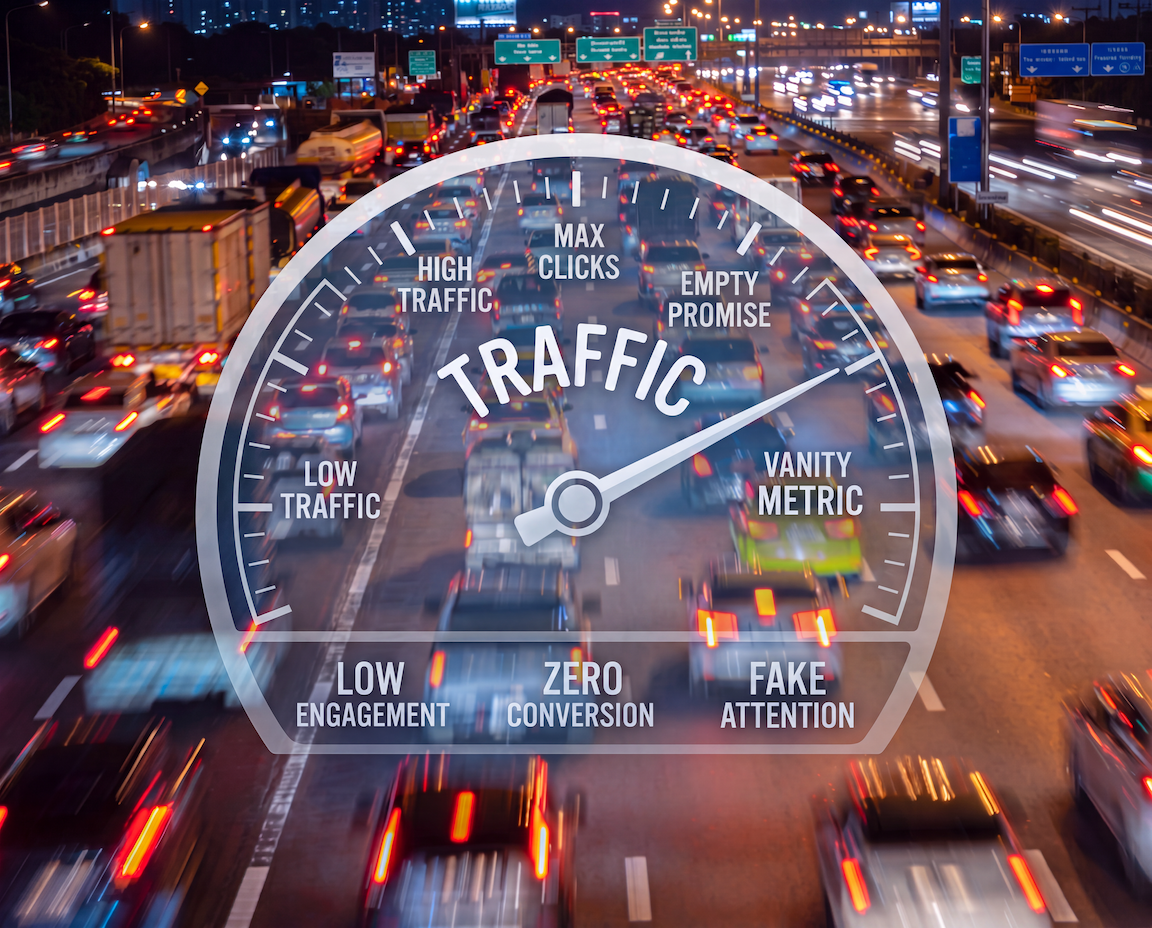
Traffic Is Becoming a Vanity Metric

If I told you your website traffic dropped by 40 percent, would you panic? Most marketers would. Now let me ask you a different question. What if qualified leads increased? What if your phone rang more often? What if your sales team closed more business? What if revenue hit a record high? Would you still care that traffic was down?
Probably not.
Because traffic was never the goal. Growth was.
For years, we've treated website traffic as one of the clearest indicators of marketing success. We built dashboards around it, celebrated monthly increases, and used it to justify budgets, strategies, and campaigns. More traffic became synonymous with better marketing. That assumption is becoming increasingly dangerous.
Not because websites don't matter.
Not because SEO is dead.
Not because people have stopped searching.
It's because the relationship between attention, discovery, and buying has fundamentally changed. I believe we're entering a period where one of marketing's favorite metrics is becoming one of its most misleading.
The Customer Journey Didn't Disappear. It Evolved.
For nearly two decades, digital marketing followed a familiar path. Someone searched. They clicked. They landed on your website. They compared a few options. Then they filled out a form, called your office, or made a purchase. Nearly every marketing dashboard was built around that journey.
- Traffic represented interest.
- Clicks represented engagement.
- Conversions represented success.
Today, customers are taking a very different path. Google increasingly answers questions directly within search results through AI Overviews. ChatGPT, Gemini, Claude, and other AI assistants summarize information, compare companies, and recommend businesses before someone ever visits a website.
People aren't searching less. They're simply clicking less.
SparkToro's latest clickstream research found that approximately 68 percent of Google searches in the United States now end without a click to another website. Bain & Company has also reported that AI assisted search experiences are accelerating zero-click behavior as consumers receive answers directly inside search experiences. That's one of the biggest shifts in digital marketing since Google became the dominant search engine. Yet many businesses are still evaluating marketing as if nothing has changed.
We've Been Optimizing for the Wrong Scoreboard
This article isn't really about AI. It's about measurement. Somewhere along the way, marketers became obsessed with activity. Website traffic. Page views. Followers. Impressions. Reach. Clicks. None of those metrics are inherently bad. The problem is that they're often mistaken for business performance.
Imagine two companies:
COMPANY A attracts 250,000 website visitors every month.
COMPANY B attracts 40,000.
If traffic is your only metric, COMPANY A appears to be winning. Now imagine COMPANY A converts one percent of those visitors into customers while COMPANY B converts six percent.
COMPANY B generates more revenue. Produces a higher return on its marketing investment. Acquires customers more efficiently. And builds a healthier business.
Which company actually has better marketing?
The answer isn't hidden in Google Analytics. It's found in the profit and loss statement. Business owners don't celebrate page views. They celebrate sales. Marketing should be measured the same way.
Visibility and Influence Are No Longer the Same Thing
For years, being visible usually meant someone visited your website. Today, that's no longer true. Let's say a business owner asks ChatGPT: "Who's the best marketing agency for a growing business?"
Your company is recommended. They don't click your website.
A few days later they hear your name again on LinkedIn. The following week a colleague recommends your company. Finally, they search your business by name, read your reviews, and schedule a consultation.
Your analytics platform credits branded search. Google Analytics says the customer came from organic search. But that's not where the decision began. The recommendation mattered. The second mention mattered. Your reputation mattered. Your content mattered.
The trust had already been built before the website visit ever happened. That's the part most dashboards never capture.
Marketing increasingly influences decisions long before analytics can measure them.
AI Isn't Replacing Marketing. It's Exposing Weak Marketing.
Whenever a major technology shift happens, businesses tend to ask the wrong question. Today that question sounds like this: "Is AI killing SEO?"
I don't think that's what's happening. AI isn't reducing the importance of great marketing. It's raising the standard.
Think about how AI systems choose what to recommend. They don't simply reward whoever publishes the most blog posts. They look for consistent expertise. Trusted brands. Authoritative content. Credible sources. Strong reputations. Positive customer experiences. Real signals of authority.
Ironically, those are the exact same things human buyers have always valued. The technology changed. Trust didn't.
Businesses that spent years chasing algorithms instead of building authority are beginning to feel that shift. Businesses that invested in expertise, education, customer experience, and brand credibility are finding themselves recommended more often.
Not because AI favors them. Because people do. AI is simply reflecting those signals at scale.
The Metrics That Matter Are Changing
I'm not suggesting businesses stop measuring website traffic. Far from it. Traffic still matters. SEO still matters. Rankings still matter. The mistake is treating those metrics as the finish line instead of the starting point.
If I were reviewing a marketing dashboard today, these are the numbers I'd care about most:
- Qualified leads.
- Sales opportunities created.
- Customer acquisition cost.
- Conversion rate.
- Branded search growth.
- Pipeline contribution.
- Customer lifetime value.
- Referral volume.
- Revenue generated.
Those metrics tell me whether marketing is creating business value. Traffic tells me someone visited a webpage.
Those aren't the same thing.
The Next Competitive Advantage Won't Be More Traffic
Every major shift in marketing changes what businesses compete for. Years ago, companies competed for rankings. Then they competed for clicks. Then they competed for attention. Today, I think they're competing for trust. Because customers don't wake up hoping to visit another website. They wake up hoping to make the right decision.
If AI can answer factual questions in seconds, businesses have fewer opportunities to make a first impression.
That means every interaction matters more. Every review. Every video. Every article. Every testimonial. Every customer experience. Every recommendation. Those moments shape buying decisions long before someone fills out a contact form. The companies that recognize this shift earliest won't necessarily have the most traffic. They'll have the strongest reputation. And reputation compounds. That's much harder for competitors to copy.
What Businesses Should Do Next
If you're evaluating your marketing based primarily on website traffic, now is the time to rethink your scorecard. Ask better questions.
"Are we attracting qualified buyers?"
"Are more people searching for our brand by name?"
"Are prospects mentioning our content during sales calls?"
"Are referrals increasing?"
"Are customers finding us through multiple touchpoints instead of one?"
"Is marketing making sales easier?"
Those questions paint a much more accurate picture of business growth than traffic ever could. The companies that adapt their measurement systems today will make better decisions tomorrow. The companies that don't may spend years optimizing numbers that become less meaningful every quarter.
Final Thought
I don't believe website traffic is becoming irrelevant. I believe it's becoming incomplete.
For years, marketers assumed a click proved they had earned someone's attention. Today, someone can discover your business, build confidence in your expertise, hear your name from multiple sources, and decide you're the right choice before ever visiting your website. That's not the end of marketing. It's the beginning of a different kind of marketing. One that's measured less by activity and more by outcomes. Less by clicks and more by confidence. Less by traffic and more by growth. Because traffic was never the objective. The customer was.